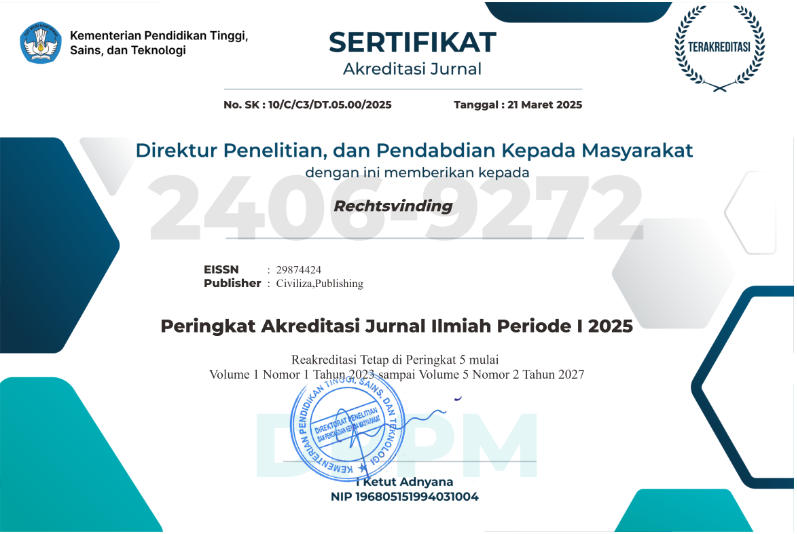
The Legal Standing And Validity Of Smart Contracts as Assessed Under The Requirements of a Valid Contract in Indonesian Civil Law
DOI:
https://doi.org/10.59525/rechtsvinding.1424Keywords:
contract validity, Indonesian civil law, smart contractAbstract
This research examines the legal standing and validity of smart contracts under the requirements of a valid contract in Indonesian civil law, particularly within the framework of Article 1320 of the Indonesian Civil Code (Burgerlijk Wetboek), which requires consent, legal capacity, a specific object, and a lawful cause. Using normative juridical research with statutory and conceptual approaches, the study analyzes civil law provisions, regulations on electronic information and transactions, and doctrinal perspectives on digital contract law. The findings indicate that smart contracts can, in principle, fulfill the elements of a valid contract, especially regarding consent and object, as long as the parties’ intentions are identifiable and the contractual terms are sufficiently clear despite being expressed in code. However, challenges remain in assessing legal capacity, ensuring genuine consent, and determining lawful cause, particularly when execution occurs autonomously without direct human involvement. Therefore, although Indonesian civil law allows their recognition, clearer legal interpretation and regulatory development are necessary to ensure legal certainty and protection of the parties.
References
Bassan, F. (2024). From smart legal contracts to contracts on blockchain: An empirical investigation. Computer Law & Security Review, 55, 106035.
Ballaji, N. (2024). Smart contracts: Legal implications in the age of automation. Beijing Law Review, 15(3), 1024–1036. https://doi.org/10.4236/blr.2024.153061
Berliana, D., Dewantara, R., & Widyanti, Y. E. (2025). Can smart contracts have a legality valid in Indonesia? International Journal of Business, Law, and Education, 6(1), 895–911. https://doi.org/10.56442/ijble.v6i1.1079
Christidis, K., & Devetsikiotis, M. (2016). Blockchains and smart contracts for the Internet of Things. IEEE Access, 4, 2292–2303. https://doi.org/10.1109/ACCESS.2016.2566339
Gan, R. O. (2012). The many faces of contractual consent. Drake Law Review, 65, 621–660.
Hartono, D., Safitri, Y., & Nugroho, A. (2024). Smart contracts and the principles of good faith and equity in Indonesian law. Journal of Digital Law and Ethics, 5(1), 23–42.
Makarim, E. (2020). Kesepakatan dan kehendak para pihak dalam kontrak elektronik. Rechten: Jurnal Riset Hukum dan Hak Asasi Manusia, 2(1), 1–15.
Mik, E. (2024). Smart contracts and the legal implications of code as law. International Journal of Law and Information Technology, 30(2), 145–162. https://doi.org/10.1093/ijlit/eaaa015
Nugroho, A. S. (2022). Smart contracts in controlled blockchain environments: A legal perspective in Indonesia. Jurnal RechtsVinding, 11(3), 305–327.
Nugroho, A. S., & Nugraha, R. W. (2020). Smart contract dalam perspektif hukum perjanjian Indonesia. Jurnal Hukum IUS QUIA IUSTUM, 27(2), 345–366.
Prasetyo, A., Lestari, R., & Santoso, B. (2023). Legal challenges of smart contracts in Indonesia: Bridging technology and civil law principles. Journal of Indonesian Legal Studies, 12(3), 145–162.
Prasetyo, D., & Nurul, R. (2022). Smart contracts and legal jurisdiction: A study on blockchain implementation in Indonesia. Jurnal RechtsVinding, 11(2), 205–228.
Pratama, A., Sari, R. F., & Wirawan, I. M. (2019). Legal and technical challenges of smart contract implementation in Indonesia. International Journal of Advanced Computer Science and Applications, 10(5), 198–204. https://doi.org/10.14569/IJACSA.2019.0100526
Purwaningsih, S., & Widyawati, A. M. J. (2023). Contract law and its development form, principles and substance. Advances in Social Science, Education and Humanities Research, 678, 123–132. https://doi.org/10.2991/assehr.k.231222.034
Putri, M. E. (2022). The validity of blockchain-based contracts under Indonesian civil code. International Journal of Law and Information Technology, 18(2), 89–105.
Shidarta. (2018). Electronic contracts and the principle of freedom of contract in Indonesian law. In Proceedings of the International Conference on Law and Society (pp. 87–95). Atlantis Press. https://doi.org/10.2991/icsl-18.2018.14
Subekti, R. (2002). Hukum perjanjian. Intermasa.
Suwardiyati, R., Widhiyanti, H. N., & Wicaksono, S. (2024). Sah atau tidak smart contract dalam sistem blockchain? Widya Yuridika: Jurnal Hukum, 7(2), 459–468. https://doi.org/10.31328/wy.v7i2.5156
Tutik, T. T. (2015). Hukum perdata dalam sistem hukum nasional. Kencana.
Wahyuni, H. A., Naili, Y. T., & Ruhtiani, M. (2023). Penggunaan smart contract pada transaksi e-commerce dalam perspektif hukum perdata di Indonesia. Jurnal Hukum In Concreto, 2(1), 1–11.
Downloads
Published
How to Cite
Issue
Section
License
Copyright (c) 2026 Chandera Halim

This work is licensed under a Creative Commons Attribution 4.0 International License.