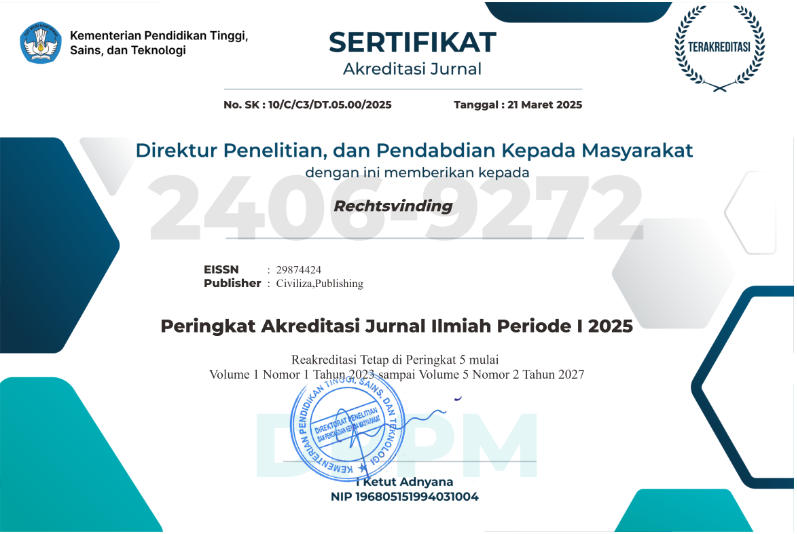
The Juridical and Managerial Effectiveness of Piece Rate Work Contracts in Optimising Production Output in the Era of Industry 4.0
DOI:
https://doi.org/10.59525/rechtsvinding.1453Keywords:
legal effectiveness, piece-rate work contract, labour productivity, production management, Industry 4.0.Abstract
Technological advancements in the Industry 4.0 era have significantly transformed personnel management and production systems in several industrial sectors. Businesses must use adaptive work management systems, such as piecework contracts, to increase production and efficiency. Piecework contracts are a type of work arrangement that prioritise employee payment based on the quantity of work they complete, which is expected to encourage increased output and efficiency. However, the implementation of this system also raises questions about managerial effectiveness in practice and compliance with labour law regulations. The purpose of this research is to evaluate the effectiveness of management and labour contract law per unit in maximising production output in the context of Industry 4.0. This research uses a normative legal research method with a legislative approach and a conceptual approach. The data sources used are primary legal materials in the form of legislation, specifically Law Number 13 of 2003 on Manpower as amended by Law Number 11 of 2020 on Job Creation, as well as secondary legal materials in the form of literature, scientific journals, and related documents. Data analysis was conducted qualitatively using a descriptive-analytical method. According to the research findings, unit-output work contracts are legally permitted as long as they meet the fundamental requirements of labour law, which include the agreement of the parties, the nature of the work performed, and the protection of workers' rights. Because it offers direct incentives to achieve production output, the unit-output work contract system is considered successful in improving productivity and work efficiency from a managerial perspective. However, monitoring systems, production quality standards, and transparency in performance evaluation mechanisms all play crucial roles in its effectiveness. According to the study's findings, unit-based work contracts can be a useful tool for maximising production output in the era of Industry 4.0 if implemented in a way that balances the needs of business productivity and the protection of workers' rights in accordance with relevant legal requirements.
References
Adha, L. A. (2020). Digitalisasi industri dan pengaruhnya terhadap ketenagakerjaan dan hubungan kerja di Indonesia. Jurnal Kompilasi Hukum, 5(2), 267–298.
Febrianti, L., Syafrinaldi, S., & Ibnususilo, E. (2021). Sistem Pengupahan Bagi Pekerja dalam Perjanjian Kerja Waktu Tertentu (PKWT) Berdasarkan Undang-Undang Nomor 13 Tahun 2003 Tentang Ketenagakerjaan. Syintax Literate: Jurnal Ilmiah Indonesia, 6(1), 573–593.
Firmansyah, M. A., & Mahardhika, B. W. (2018). Pengantar manajemen. Deepublish.
Hafizh, D. F., Maghribi, G., Mulyani, R., Afradyta, S. R., & Fernanda, S. (2022). Analisis Praktik Outsourcing Dalam Perspektif Undang-Undang Cipta Kerja. Jurnal Lemhannas RI, 10(3), 212–223.
Harahap, L. M., Wudda, A. R., Zulfri, A., Fonataba, P. W., & Sitorus, S. I. (2025). Implikasi Revolusi Industri 4.0 Terhadap Perubahan Struktur Ekonomi Indonesia: Sebuah Studi Literatur. Jurnal Bisnis Dan Manajemen (JURBISMAN), 3(1), 93–108.
Listy, V., & Ilham, I. (2025). Revolusi sistem informasi manajemen di era ai dan big data mengubah cara bisnis bekerja. Simpatik: Jurnal Sistem Informasi Dan Informatika, 5(1), 27–36.
Putri, E. O. W. (2024). Transformasi Kontrak Dalam Era Digital: Tantangan Hukum Bisnis Dalam Transaksi Elektronik Di Bisnis Sewa Kebaya Online. Universitas Islam Sultan Agung Semarang.
Sastrohadiwiryo, S., & Syuhada, A. H. (2021). Manajemen tenaga kerja Indonesia. Bumi aksara.
SUHERNI, S. (2023). SISTEM PENGUPAHAN DALAM PEMENUHAN HIDUP KARYAWAN KONTRAK SEKRETARIAT DAERAH KABUPATEN LUWU. Institut Agama Islam Negeri (IAIN) Palopo.
TESSALONIKA, T. (2025). TINJAUAN YURIDIS ATAS UPAH YANG TIDAK SESUAI DENGAN PERJANJIAN KERJA BERDASARKAN UU NO 13 TAHUN 2003 TENTANG KETENAGAKERJAAN.
Trinil Muktiningrum, S. T., & MT, M. (2025). Buku Manajemen Industri. Penerbit Widina.
Zulfikar Putra, S. H., & Darmawan Wiridin, S. H. (2022). Implementasi Upah Minimum Terhadap Kesejahteraan Pekerja. Ahlimedia Book.
Downloads
Published
How to Cite
Issue
Section
License
Copyright (c) 2026 Fajar Basuki

This work is licensed under a Creative Commons Attribution 4.0 International License.