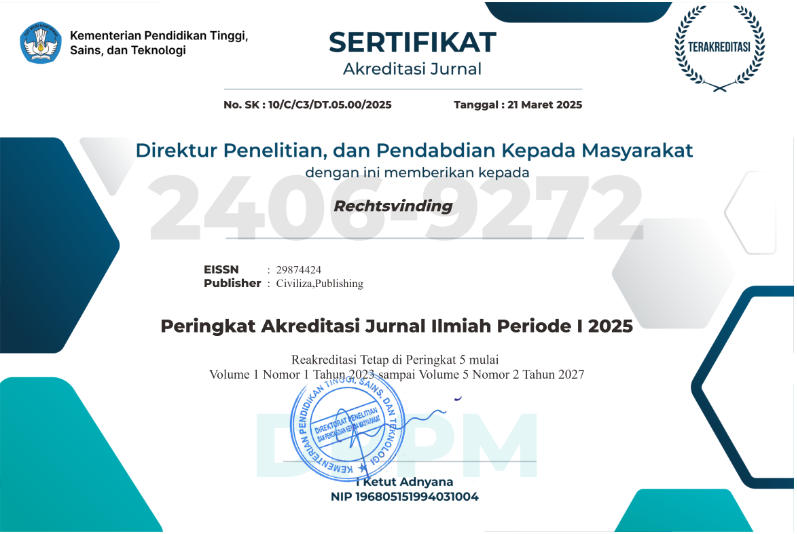
Islamic Family Law and International Inheritance: An Analysis of Mixed Marriages from the Perspective of International Civil Law
DOI:
https://doi.org/10.59525/rechtsvinding.1769Keywords:
Mixed Marriages, International Inheritance, Islamic Family LawAbstract
Globalization has increased the number of mixed-nationality and interfaith marriages, giving rise to cross-jurisdictional legal complexities, particularly for Muslim parties. This study aims to analyze the application of the principles of Private International Law—namely, lex patriae, lex domicilii, lex loci celebrationis, and lex rei sitae—in the resolution of disputes regarding mixed-nationality marriages and international inheritance. The methodology employed is normative legal research using a comparative law approach and analysis of court decisions. The results of the study indicate that the validity of mixed marriages is determined through a combination of formal requirements based on lex loci celebrationis and substantive requirements subject to lex patriae or lex domicilii, which often conflict with Sharia norms and the public policy of the forum state. In international inheritance, the differences between the faraidh system and Western law lead to fragmentation in dispute resolution, particularly regarding immovable property governed by lex rei sitae. To reduce legal uncertainty, cross-jurisdictional marriage contracts, international wills, mandatory bequests, and asset transfers that comply with the principle of dual compliance are necessary. This study underscores the importance of harmonizing national law, religious law, and human rights
References
Ahmad. (2020). Harmonization of Islamic Family Law in a Global Context. Jakarta: Kencana.
Ali, M. A. (2018). Conflict of Laws in Islamic Jurisprudence. Kuala Lumpur: International Islamic University Press.
Al-Jaziri, A. (2003). “The Concept of Mixed Marriage in Contemporary Islamic Jurisprudence.” Journal of Islamic Law Studies, 15(2), 45–67.
Auda, J. (2008). Maqasid al-Shariah as Philosophy of Islamic Law: A Systems Approach. London: IIIT.
B. Journals and Scholarly Articles
Banten, M., & Kariel, F. (2020). Mixed Marriages and Their Legal Implications in Indonesia. Yogyakarta: UII Press.
Bisri, H. (2019). Islamic Marriage Law in Indonesia: Theory and Practice. Jakarta: Rajawali Pers.
Castles, S., & Miller, M. J. (2009). The Age of Migration: International Population Movements in the Modern World (4th ed.). Basingstoke: Palgrave Macmillan.
Cheshire, G. C., North, P. M., & Fawcett, J. J. (2021). Private International Law (15th ed.). Oxford: Oxford University Press.
Court of Appeal of England and Wales. (2020). Akhter v. Khan [2020] EWCA Civ 122. London: Royal Courts of Justice.
Ministry of Religious Affairs of the Republic of Indonesia. (2019). The Qur’an and Its Translation. Jakarta: Lajnah Pentashihan Mushaf Al-Qur’an.
Dicey, A. V., Morris, J. H. C., & Collins, L. (2022). Dicey, Morris & Collins on the Conflict of Laws (16th ed.). London: Sweet & Maxwell.
Emon, A. E. (2016). Islamic Natural Law and Natural Law: A Study in Islamic Legal Philosophy. Oxford: Oxford University Press.
Family Court of Australia. (2018). Al-Sheikh v Al-Sheikh [2018] FamCA 123. Sydney: Federal Circuit and Family Court of Australia.
Government of Singapore. (1961). Women’s Charter. Singapore: Attorney-General’s Chambers.
Hague Conference on Private International Law. (1978). Convention on the Celebration and Recognition of the Validity of Marriages. The Hague: HCCH.
Hague Conference on Private International Law. (1989). Convention on the Law Applicable to Succession to the Estates of Deceased Persons. The Hague: HCCH.
Hague Conference on Private International Law. (2021). Guiding Principles on the Recognition of Religious Marriages. The Hague: HCCH.
Hasan, M. (2019). Islamic Inheritance Law from a Comparative Perspective. Bandung: Remaja Rosdakarya.
Ibn Qudamah. (1997). Al-Mughni (Vol. 7). Riyadh: Dar 'Alam al-Kutub.
Kamali, M. H. (2008). Shari’ah Law: An Introduction. Oxford: Oneworld Publications.
Ministry of Religious Affairs of the Republic of Indonesia. (2023). Marriage and Divorce Statistics for 2022. Jakarta: Directorate General of Islamic Community Guidance.
Kusumaatmadja, M. (2020). Introduction to Indonesian Private International Law. Bandung: Citra Aditya Bakti.
Lie, R. (2020). Human Rights and Islamic Family Law: Challenges and Opportunities. Leiden: Brill Publishers.
Liebkind, C., Jasinskaja-Lahti, I., & Mähönen, T. (2014). “Intercultural Marriages: A Review of Research.” Journal of Comparative Family Studies, 45(3), 321–340.
Supreme Court of the Republic of Indonesia. (2018). Decision No. 145 K/Ag/2018. Jakarta: Supreme Court of the Republic of Indonesia.
Indonesian Ulema Council. (2005). MUI Fatwa No. 4 of 2005 on Interfaith Marriage. Jakarta: MUI.
New South Wales Parliament. (2006). Succession Act 2006 (NSW). Sydney: NSW Legislation.
Nurhayati, S. (2021). Interfaith Marriage: Legal Issues and Solutions. Jakarta: Sinar Grafika.
Nurlaelawati, E. (2010). Religious Courts and Islamic Family Law in Indonesia. Leiden: Brill Publishers.
Government of the Republic of Indonesia. (1974). Law No. 1 of 1974 on Marriage. Official Gazette of the Republic of Indonesia, 1974, No. 1. Jakarta: State Secretariat.
Government of the Republic of Indonesia. (1991). Presidential Instruction No. 1 of 1991 on the Dissemination of the Compilation of Islamic Law. Jakarta: State Secretariat.
Government of the Republic of Indonesia. (1999). Law No. 39 of 1999 on Human Rights. Official Gazette of the Republic of Indonesia, 1999, No. 165. Jakarta: State Secretariat.
Government of the Republic of Indonesia. (2019). Law No. 16 of 2019 Amending Law No. 1 of 1974 on Marriage. Official Gazette of the Republic of Indonesia, 2019, No. 186. Jakarta: State Secretariat.
Central Jakarta District Court. (2019). Judgment No. 1234/Pdt.G/2019/PN.Jkt.Pst. Jakarta: Central Jakarta District Court.
Pratama, A. (2020). International Civil Law: Theory and Application. Surabaya: Airlangga University Press.
Rahman, F. (2017). Islam and Modernity: The Transformation of Intellectual Tradition. Bandung: Mizan.
Satria, E. (2018). Islamic Marriage Law in Indonesia. Jakarta: Kencana.
Shihab, Q. (2017). Tafsir Al-Mishbah: The Message, Impact, and Harmony of the Qur'an (Vol. 2). Jakarta: Lentera Hati.
Supreme Court of Canada. (2017). Estate of Ahmed [2017] SCC 45. Ottawa: Supreme Court of Canada.
Supreme Court of New South Wales. (2019). Re Estate of Farag [2019] NSWSC 456. Sydney: NSW Courts.
Taher, H. (2019). Islamic Inheritance Law: Theory and Practice. Jakarta: Rajawali Pers.
Zuhayli, W. (2015). Al-Fiqh al-Islami wa Adillatuhu (Vol. 9). Damascus: Dar al-Fikr.
Downloads
Published
How to Cite
Issue
Section
License
Copyright (c) 2026 Sahrul Hanafi, Nurman Akhmadi, Siah Khosyi’ah, Ahmad Fathoni

This work is licensed under a Creative Commons Attribution 4.0 International License.