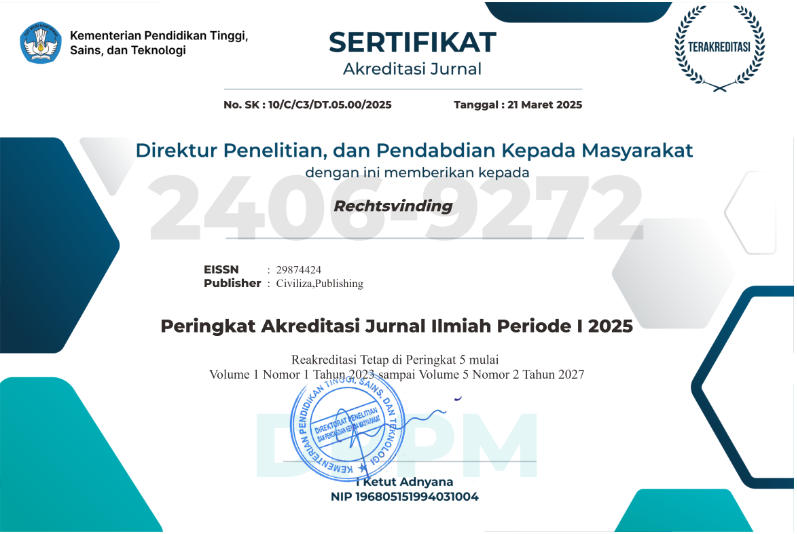
Non-Conviction Based Asset Forfeiture (NCBAF) as an Asset Recovery Instrument in Indonesia: Juridical Analysis and Justice Perspective
DOI:
https://doi.org/10.59525/rechtsvinding.1991Keywords:
Non-Conviction Based Asset Forfeiture (NCBAF); Asset Forfeiture; Asset Recovery; JusticeAbstract
The confiscation of assets resulting from criminal acts is an important instrument in supporting the eradication of crime oriented to economic profit. This research focuses on a juridical analysis of the Non-Conviction Based Asset Forfeiture (NCBAF) mechanism as an instrument of asset forfeiture without a criminal verdict and its relevance in realizing justice in the Indonesian legal system. The purpose of the study is to analyze the legal basis, implementation mechanism, and potential of NCBAF in supporting the effectiveness of asset recovery. This research uses normative legal methods with laws and regulations, conceptual, and case approaches. Data were obtained through literature studies on primary, secondary, and tertiary legal materials, then analyzed qualitatively by descriptive-analytical methods. The results show that NCBAF has a normative foundation in UNCAC, UNTOC, and FATF recommendations, but has not been comprehensively regulated in the Indonesian legal system. The implications of the study confirm the need for special regulations regarding NCBAF to strengthen the effectiveness of asset recovery while ensuring legal certainty, protection of property rights, and the principle of due process of law.
References
Anom, S. (2025). The Role of Judges in Realizing Due Process of Law in the System. Journal of Legal Concepts, 5(1), 1–12.
Armaijn, L., Darmayanti, D., Sonia, B., & Rochmat, H. (2024). No Title 済無No Title No Title. 2, 306–312.
Azzahra, A. N. (2026). The Urgency of Asset Forfeiture Regulations in the Implementation of Non-Conviction Based Asset Forfeiture as an Instrument for Corruption Eradication. Equality: Law and Social, 1(3), 179–187.
Based, K., & Law, K. (2024). In Rem Asset Forfeiture Model in Abstract Matter Keywords Introduction. 1(2).
Fadhila, Y. R. (2025). Third Parties in Non-Conviction Based Asset Forfeiture Againts Corruption (UNCAC) . 4 Convention initiated by the United Nations-b. 8(3), 8–11.
Firdaus, M. B. (2025). The Dialectic of Justice, Certainty, and Legal Utility in Gustav Radbruch's Perspective on Indonesian Law. Journal of Legal and Public Policy Studies, 3(1), 357–367. https://jurnal.kopusindo.com/index.php/jkhkp/article/view/1320
IMMIGRATION, T. P. (2023). The threat of transnational crime to Indonesian sovereignty and its influence on immigration. In PT Dewangga Energi International. https://www.academia.edu/download/107659302/Buku_Ancaman_Kejahatan_Transnasional_FINAL.pdf#page=137
Iskandar, Hidayat, T., Nugraha, H., & Putra, R. F. L. (2026). The Asset Forfeiture Bill for Perpetrators of Corruption Crimes in the Perspective of Criminal Objectives and Human Rights: A Normative Analysis. The Principle of Wa Tandhim: Journal of Legal, Educational and Social Religion, 5(2), 599–622. https://jurnal.ucy.ac.id/index.php/awtjhpsa/article/view/3462
Kadriah, A., & Sumarna, D. (2024). Critical epistemological analysis of civil law research methods. Supermacy Journal Of Law, 1(1), 1–25.
Corruption, P., Washing, D., Wahyu, M., & Kariyasa, I. M. (2026). Juridical analysis of asset forfeiture with the concept of non-conviction based asset forfeiture (NCBAF) in action. pp. 6(01), 245–251.
Lina, A. A., Theresia, M., Affrilies, M. H., & Fajri, P. C. (2025). Compliance Asymmetry in the Self-Assessment System: A Juridical Analysis of Non-Criminal Asset Forfeiture and Mandatory Disclosure Rules in Indonesia. National Seminar on Research and Community Service, 211–222.
Maghfiroh, L. (2025). Realizing Justice As Fairness: An Analysis of the Inequality of Health Services in Indonesia According to John Rawls' Theory. Indonesian Legal Media (MHI), 3(4), 225–232. https://doi.org/10.5281/zenodo.17433104
Problem, A. L. B. (2009). Moh. Mahfud MD, 2009,. 1–100.
Natasya Klarisa Paruntu, & Amad Sudiro. (2025). A Paradigm Shift in Asset Recovery in Corruption Crimes to Realize the Optimization of State Loss Returns. Journal of the U.S. Law Review, 8(3), 1903–1929. https://doi.org/10.26623/julr.v8i3.12888
Ncb, B., Returns, D., & Nation, K. (2026). ASSET CONFISCATION THROUGH A NON-CONVICTION APPROACH AS A RESULT OF INDONESIAN CORRUPTION CRIMES.
Banking, D. I. B., & Mughozi, B. J. (2023). By : 1. 1–24.
Prasetyo, Z. M., Malinda, I. P., J, C. S. P., Azzahra, L. A., N, S. R., & Hadji, K. (2025). Synchronization of Law Enforcement Policies: The Position of the Asset Forfeiture Bill in the Indonesian Legal System. Journal of Nusantara Research, 4(2), 801–808. https://padangjurnal.web.id/index.php/menulis/article/download/862/833/1089
Rasji, & Harmono, H. (2025). Rewang Rencang : Lex Generalis Law Journal. Vol.5. No.10 (2024) Theme/Edition: Philosophy, Politics and Ethics of the Legal Profession (Tenth Month) https://jhlg.rewangrencang.com/. Rewang Rencang : Lex Generalis Law Journal, Vol. 5, (No. 10), p.4. https://ojs.rewangrencang.com/index.php/JHLG/article/view/939
Safita, N., & Siregar, M. (2026). NEOCLASSICAL LEGAL REVIEW : JOURNAL OF The Role of International Law in Combating Money Laundering through the Regulation of International Cooperation. pp. 5(01), 60–70.
Tarigan, E. K., Darmayanti, E., & Gaddafi, M. (2025). Non-Conviction Bases Asset Forfeiture Strategy in an Effort to Recover State Losses due to Corruption Crimes. Lex Justitia Journal, 7(2), 43–55.
Usfunan, J. Z., & Hermanto, B. (2024). The Dynamics of Legislation and Regulation Approaches in Improving the Quality and Ius of the Indonesian Legislative Constituendum. National Conference of Teachers Association of Constitutional Law and State Administrative Law, 2(1), 197–234. https://doi.org/10.55292/bnfgen89
Downloads
Published
How to Cite
Issue
Section
License
Copyright (c) 2026 Wahyudi Wahyudi, Muhammad Islahuddin

This work is licensed under a Creative Commons Attribution 4.0 International License.