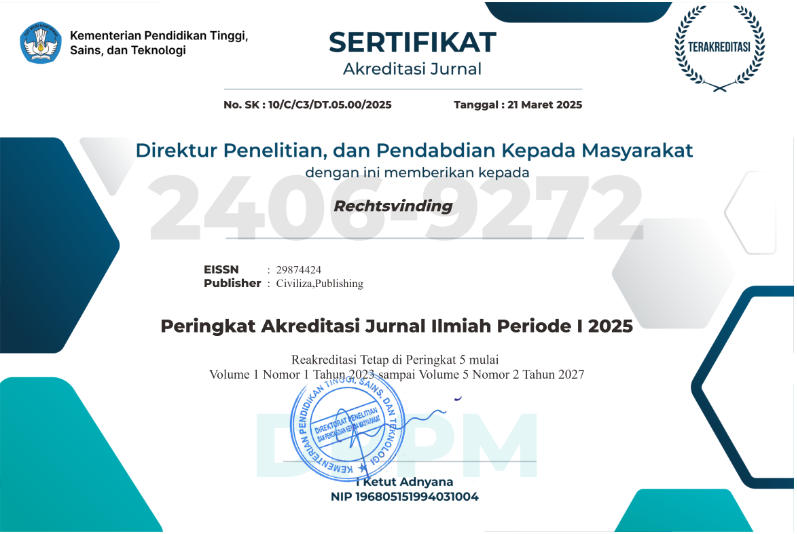
Legal Construction of Sting Operations in the Emptiness of Criminal Procedure Norms
DOI:
https://doi.org/10.59525/rechtsvinding.v3i2.1188Keywords:
Sting Operation, Legal Certainty, Due Process of LawAbstract
Hand-caught Operations (OTT) are a law enforcement practice frequently used to eradicate corruption, but their implementation has generated legal debate because they are not explicitly regulated in criminal procedural law. This study aims to analyze the legal construction of Hand-caught Operations in the absence of criminal procedural law norms and to assess their compliance with the principle of due process of law. The research method used is normative legal research with a statutory and conceptual approach. Legal materials are analyzed qualitatively through a review of criminal procedural law provisions, laws and regulations related to corruption eradication, and relevant legal doctrines. The results show that Hand-caught Operations are legally constructed through a broad interpretation of the concept of being caught red-handed, rather than based on firm procedural regulations. This condition creates legal uncertainty and has the potential to weaken the guarantee of protection of the suspect's rights. The study's conclusion confirms that although Hand-caught Operations have been effective in law enforcement practices, their sustainability requires clear procedural regulations to ensure legal certainty, justice, and the protection of human rights in the criminal justice system
References
Angkasa, A. (2017). Due Process of Law in the Indonesian Criminal Justice System. Ius Quia Iustum Law Journal. 24(3): 405–423.
Arifin, R. & Lestari, EY (2019). Law Enforcement and Protection of Human Rights in the Criminal Justice Process. Constitutional Journal. 16(1): 1–20.
Atmasasmita, R. (2018). Contemporary Criminal Justice System. Jakarta: Kencana.
Hamzah, A. (2016). Indonesian Criminal Procedure Law. Jakarta: Sinar Grafika.
Harahap, MY (2012). Discussion of Problems and Application of the Criminal Procedure Code. Jakarta: Sinar Grafika.
Kurniawan, R. (2020). Sting Operations from a Criminal Procedure Law Perspective. Judicial Journal. 13(2): 211–230.
Marzuki, PM (2017). Legal Research. Jakarta: Kencana.
Muladi. (2010). Human Rights, Politics, and the Criminal Justice System. Semarang: Diponegoro University Publishing Agency.
Prakoso, D. (2019). Reform of Criminal Procedure Law. Jakarta: LaksBang Pressindo.
Prayitno, I. (2018). Legality of Sting Operations by the Corruption Eradication Commission. Jurnal Rechtsvinding. 7(3): 423–440.
Putra, A. & Nugroho, B. (2021). Interpretation of Caught Red-Handed in the Practice of Law Enforcement of Corruption Crimes. Journal of Law and Justice. 10(2): 257–276.
Siregar, NSS (2016). Level of Public Awareness of Law Enforcement. Journal of Government and Social Politics, UMA. 4(1): 1–10.
Downloads
Published
How to Cite
Issue
Section
License
Copyright (c) 2025 Ahmad Sholihin, Hamdani Cibro

This work is licensed under a Creative Commons Attribution 4.0 International License.