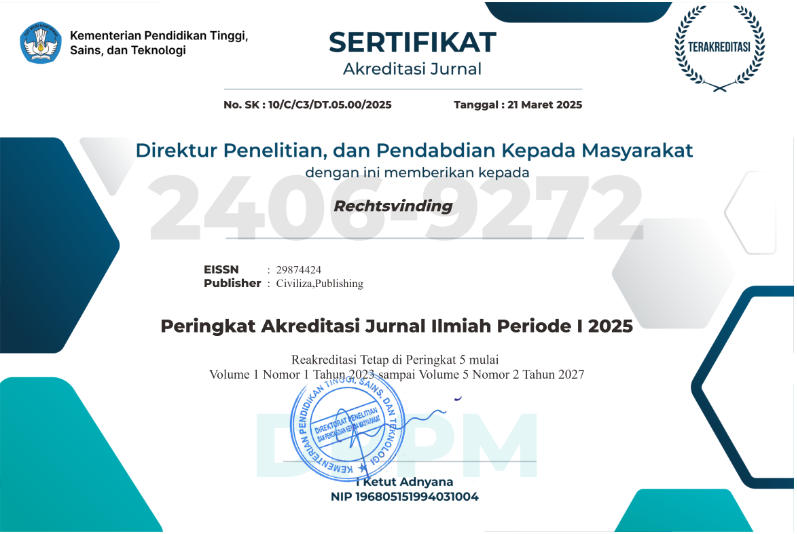
Due Process of Law and the Principle of Al-'Adalah in the Selection of Constitutional Judges: A Critique of the Single Candidate Method
DOI:
https://doi.org/10.59525/rechtsvinding.1765Keywords:
Due process of law; Al-'adalah; Selection of Constitutional Judges; Single Candidate Commission III of the DPRAbstract
The practice of selecting a single candidate for constitutional judges by Commission III of the House of Representatives (DPR) has emerged as a serious issue, as it violates the due process of law and contradicts the principle of al-’adalah in Islamic law. The closed nature of this process, which lacks public participation and is heavily influenced by transactional politics, threatens the independence of the Constitutional Court as the ultimate guardian of the rule of law. This study employs library research, utilizing data sources such as books, scientific journal articles, research reports, and official documents. The research reveals three primary findings. First, the single-candidate method breaches the principles of due process of law—particularly fairness, transparency, and the opportunity to be heard—and subsequently deprives other potential candidates of their constitutional rights. Second, this approach is inconsistent with the principle of al-’adalah, as it disregards both procedural and substantive justice, violates the 'adalah requirement for candidates, and dismisses al-musyawarah alongside the prohibition of al-muhasabah. Third, the convergence of these two principles provides a comprehensive critical framework and proposes an ideal selection model based on five pillars: an independent committee, open registration, a screening process, public examination, and final selection by the DPR. The study concludes that the single-candidate practice must be abolished, as it undermines the legitimacy of the recruitment process and the authority of the Constitutional Court. The practical implementation of these findings involves public advocacy, legislative revisions, and a fundamental shift in the political culture of the elite.
References
Arjomand, S. A. (2023). Constitutional courts and political democracy: A comparative institutional analysis. Oxford University Press.
Azmi, U., Rosadi, K. I., & Zebua, A. M. (2022). The Urgency Of Ihsan And Thinking Systemic In Increasing Motivation And Quality Of Education. Jurnal Ilmiah Teunuleh, 3(2), 83-92. https://doi.org/10.51612/teunuleh.v3i2.88
Bickel, A. M. (2022). The least dangerous branch: The Supreme Court at the bar of politics (3rd ed.). Yale University Press.
Bryman, A. (2021). Social research methods (6th ed.). Oxford University Press.
Craig, P. (2021). Administrative law (9th ed.). Sweet & Maxwell.
Creswell, J. W., & Poth, C. N. (2022). Qualitative inquiry and research design: Choosing among five approaches (5th ed.). SAGE Publications.
Farihy, A., A.P, M. G., & Ansori, L. (2025). Political intervention in the independence of the Constitutional Court in Indonesia. Tanfizi: Journal of Islamic Constitutional and Political Law, 1(2), 179–191. https://doi.org/10.30983/tanfizi.v1i2.10520
Flick, U. (2024). Pengantar metodologi penelitian kualitatif: Sebuah pendekatan komprehensif. Penerbit Pustaka Pelajar.
Hallaq, W. B. (2022). Otoritas, kesinambungan, dan perubahan dalam hukum Islam. Penerbit Marjin Kiri.
Khallaf, A. W. (2022). Ilmu usul fikih: Kaidah-kaidah hukum Islam. Penerbit Al-Azhar Press.
Komnas HAM. (2025). Laporan pemantauan independensi peradilan di Indonesia 2024-2025. Komisi Nasional Hak Asasi Manusia. (Catatan: Laporan ini diterbitkan sebagai buku oleh Komnas HAM)
Krippendorff, K. (2023). Analisis isi: Pengantar teori dan metodologi (Edisi ke-4, Terjemahan). Penerbit Rajawali Pers.
Maududi, A. A. (2023). Khilafah dan kerajaan: Evaluasi kritis atas sejarah politik Islam. Penerbit Pustaka Hidayah.
Saifullah, Kharlie, A. T., & Supriyadi, A. P. (2022). The decision of constitutional justices: Between juridical considerations and Islamic values in the Indonesian legal system. Kasetsart Journal of Social Sciences, 43(4), 921–930. https://so04.tci-thaijo.org/index.php/kjss/article/view/261660
Satriawan, I., Lee, S., Wijayanti, S. N., & Hidayat, B. (2023). An evaluation of the selection mechanism of constitutional judges in Indonesia and South Korea. PJIH, 10, 122–147.
Soedirjo, A. T., & Santiago, F. (2024). Political dynamics in the selection of judges of the Constitutional Court of Indonesia: A critical analysis. Journal of World Science, 3(3), 428–439. https://doi.org/10.58344/jws.v3i3.585
Walangitan, S. (2025). Independensi Mahkamah Konstitusi di tengah tekanan politik. Indonesia of Journal Business Law, 4(2), 45–56. https://doi.org/10.47709/ijbl.v4i2.6596
Wantu, F. M., Nggilu, N. M., Imran, S., et al. (2021). Proses seleksi hakim konstitusi: Problematika dan model ke depan. Jurnal Konstitusi, 18.
Downloads
Published
How to Cite
Issue
Section
License
Copyright (c) 2026 Anisa Anisa

This work is licensed under a Creative Commons Attribution 4.0 International License.