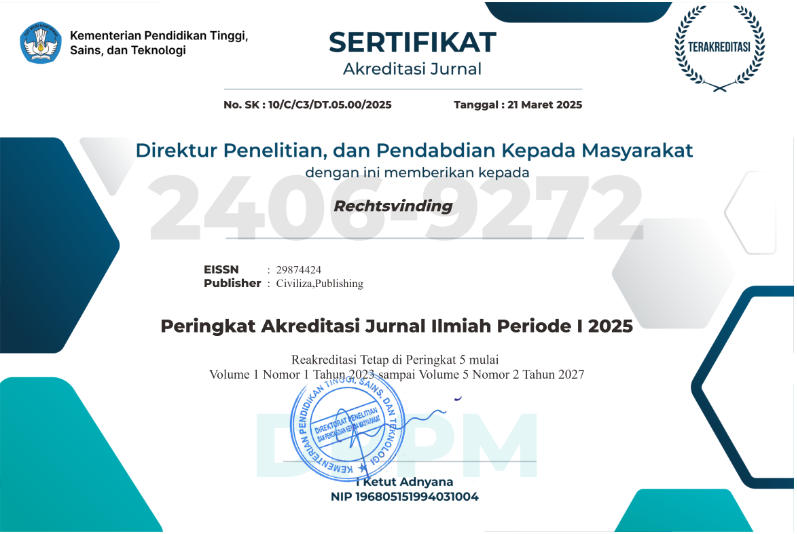
Obstacles to Law Enforcement Against Trademark Infringement in E-Commerce Transactions: A Study of the Effectiveness of Law Number 20 of 2016 concerning Trademarks and Geographical Indications
DOI:
https://doi.org/10.59525/rechtsvinding.1902Keywords:
Law Enforcement; Platforms; Brands; E-CommerceAbstract
This study examines the challenges of enforcing trademark law in Indonesia amid the rapid growth of e-commerce. Trademark infringement in digital transactions not only causes economic losses for brand owners but also exposes limitations in the effectiveness of Law Number 20 of 2016 concerning Trademarks and Geographical Indications. Using a normative juridical method with legislative, conceptual, and case approaches, the research analyzes primary legal materials (laws and court decisions), supported by secondary and tertiary sources. Data are analyzed qualitatively through reduction, presentation, and conclusion drawing. The findings reveal several key obstacles. First, technical barriers include limited infrastructure and inadequate digital forensic capabilities to detect and prove online violations. Second, capacity constraints arise from the insufficient understanding of law enforcement officials regarding technology-based infringement models. Third, jurisdictional complexities and cross-border trade present significant challenges, as e-commerce transactions often involve multiple legal systems, leading to conflicts of jurisdiction. The study concludes that the effectiveness of Law Number 20 of 2016 remains limited in addressing trademark protection in the digital era. To improve enforcement, it recommends strengthening derivative regulations, enhancing the technical and legal capacity of law enforcement agencies, and fostering international cooperation to address cross-border legal issues. These measures are essential to ensure more effective trademark protection in Indonesia’s evolving digital economy.
References
Abdul, A., Wiyono, R., & Kurniawan, N. D. (2025). JURNAL AR RO ’ IS MANDALIKA ( ARMADA ) Tanggung Jawab Hukum dalam Perdagangan E- Commerce Lintas Negara. 5(2), 249–259.
Agustina, R. (2020). Perlindungan Hukum Merek Terdaftar dalam Perdagangan Elektronik di Indonesia. Jurnal Hukum IUS QUIA IUSTUM, 27(2), 345–362.
Bank Indonesia. (2024). Laporan Perkembangan Transaksi E-Commerce di Indonesia 2024. Bank Indonesia.
Bok Rok Su, G. L. dan M. R. S. P. (2025). KEKOSONGAN HUKUM DAN KETIDAKJELASAN TANGGUNG JAWAB PLATFORM E-COMMERCE ATAS PRODUK ILEGAL DALAM TRANSAKSI DIGITAL. 6(4), 1–16.
Daw. (2025, September). DJKI Dorong Revisi UU Merek dan Indikasi Geografis untuk Daya Saing Global. Rabu 17 September. https://www.dgip.go.id/artikel/detail-artikel-berita/djki-dorong-revisi-uu-merek-dan-indikasi-geografis-untuk-daya-saing-global?kategori=pengumuman&utm_source=chatgpt.com
El, M. R. et. (2025). Legal Liability of E-Commerce Site Against Sales of Counterfeit Trademarks Products. Jurnal Mercatoria, 18(1), 42–53.
Erma, Z., & Tulim, A. (2019). Jurnal Teknologi , Kesehatan dan Ilmu Sosial Penegakan Hukum Terhadap Pelanggaran E-Commerce Jurnal Teknologi , Kesehatan dan Ilmu Sosial. 1(1).
Fernaldi, K., Agustin, K. P., Sari, M. C. A., Maf’ula, S. D., & Nizan, S. B. R. (2025). Peran Hukum Dagang dalam Menjamin Perlindungan terhadap Hak Kekayaan Intelektual UMKM di Indonesia. Lentera Ilmu, 1(2), 105–112. https://doi.org/10.59971/li.v1i2.59
Fitriani, Imadatul, Inayah Maulia, and L. D. (2025). Perlindungan Hukum terhadap Konsumen dalam Transaksi E-Commerce Lintas Negara. Al-Zayn: Jurnal Ilmu Sosial & Hukum, 3(3), 1387-1397.
Indrawati, E., Susilawati, M. D., & Handoyo, R. W. (2025). Efforts to Handle and Prevent Trademark Infringement in E- Commerce Business in Indonesia. 3(02), 201–211.
Ishep. (2025). Perlindungan Hukum Terhadap Konsumen Atas Peredaran Produk Palsu Di Pasar Digital. JUKAHU : Jurnal Kajian Hukum, 1(1), 9–16.
Made, N., Sutari, P., Hukum, F., & Warmadewa, U. (2020). PERLINDUNGAN HUKUM MEREK TERKENAL TERKAIT DENGAN. 1(1), 13–18.
Nugroho, B. (2022). Penegakan Hukum Hak Kekayaan Intelektual pada Platform E-Commerce. 19(3), 401–418.
Rekan, M. S. dan. (2024, May). Livestream shopping thwarts some high-tech tools to stop fake merc. 7 Mei.
Reuters. (2024, June 27). E-commerce firm Shopee to adjust services in Indonesia after antitrust violation,. 27 June. https://www.reuters.com/business/retail-consumer/indonesia-says-e-commerce-firm-shopee-admits-violating-monopoly-rule-2024-06-26/?utm_source=chatgpt.com.
Smith, J. (2022). E-commerce and consumer protection: Challenges in the digital age. Universitas Indonesia Press.
Soelistyo, H. (2018). Hukum Kekayaan Intelektual dalam Perspektif Globalisasi. Refika Aditama.
Tamaela, K. W. (2025). Perlindungan Hukum terhadap Konsumen dalam Kegiatan Transaksi Elektronik ( E-Commerce ): Perspektif Undang - Undang Perlindungan Konsumen. 03(03), 75–85.
Thalib, E. F., Putu, N., & Meinarni, S. (2021). Liability of Marketplace as Electronic System Provider in Regard to System Failure Occured on Online Transactions. 1, 1–9.
Downloads
Published
How to Cite
Issue
Section
License
Copyright (c) 2026 Eko Bambang Rahmono, Edy Mulyanto, Desi Ratnasari

This work is licensed under a Creative Commons Attribution 4.0 International License.