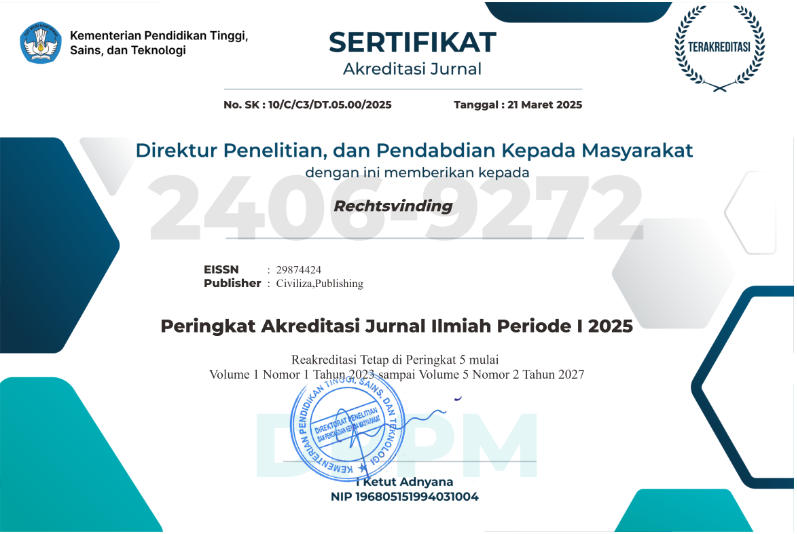
Legal Construction of Immaterial Compensation for Telecommunication Service Users Due to Violations of Consumer Rights
DOI:
https://doi.org/10.59525/rechtsvinding.1961Keywords:
Compensation for Immaterial Losses; Telecommunication Services; Legal ProtectionAbstract
The development of information and communication technology has made telecommunications services a vital necessity in people's lives. The high dependence on telecommunications services requires providers to ensure the availability of quality, safe, continuous services that comply with consumer rights. However, in practice, telecommunications service users still have the potential to experience losses due to service disruptions, system failures, misuse of personal data, information leaks, or disproportionate service terminations. These losses are not only material but can also include immaterial losses, such as discomfort, anxiety, loss of security, disruption of privacy, and psychological stress. This study aims to analyze the legal construction of providing compensation for immaterial losses to telecommunications service users due to violations of consumer rights. This study uses a normative juridical method with a statutory and conceptual approach. The results show that the legal liability of telecommunications service providers can be constructed through an integration of consumer protection law, civil law, telecommunications law, and personal data protection. However, there are no comprehensive parameters regarding the proof and assessment of immaterial losses. Therefore, it is necessary to strengthen the legal construction oriented towards the restoration of rights, legal certainty, and substantive justice for consumers
References
Central Bureau of Statistics. (2023). Indonesian telecommunications statistics 2022. Central Bureau of Statistics.
Central Bureau of Statistics. (2024). Indonesian telecommunications statistics 2023. Central Bureau of Statistics.
Central Bureau of Statistics. (2025). Indonesian telecommunications statistics 2024. Central Bureau of Statistics.
Civil Code.
Dewi, NKAS, & Sulistyawan, IW (2024). Legal protection of personal data in the implementation of electronic systems and the responsibilities of data controllers. Kertha Semaya Journal, 12(4), 1–15.
Fuady, M. (2017). Unlawful acts: A contemporary approach. Citra Aditya Bakti.
Furqan, F., Hamza, YA, & Sapada, AT (2025). Analysis of the legal responsibility of telecommunications operators in cases of personal data leaks due to recycled mobile phone numbers. Legal Dialogica, 1(1).
Government Regulation Number 71 of 2019 concerning the Implementation of Electronic Systems and Transactions.
Hadjon, PM (1987). Legal protection for the people in Indonesia: A study of its principles, its handling by the courts in the general judicial environment and the formation of state administrative courts. Bina Ilmu.
Indonesian Consumers Foundation. (2022). 2022 Consumer Complaints Report. YLKI.
Johan, S. (2022). Consumer protection in digital transactions and business actors' liability for consumer losses. IUS QUIA IUSTUM Law Journal, 29(3), 521–540.
Kaeng, AA, Sumiyati, B., Arpin, A., & Andini, NQ (2024). Legal protection against the dissemination of personal data in online loans. Unisan Law Review, 9(2).https://doi.org/10.37195/ulr.v9i2.1045
Kamba, MN (2018). Today's Kids Rediscover Islam. South Tangerang: IIMaN Library.
Law Number 27 of 2022 concerning Personal Data Protection.
Law Number 36 of 1999 concerning Telecommunications.
Law Number 6 of 2023 concerning the Stipulation of Government Regulation in Lieu of Law Number 2 of 2022 concerning Job Creation into Law.
Law Number 8 of 1999 concerning Consumer Protection.
Lynskey, O. (2015). The protection of individuals' personal data in the context of the EU's data protection reform. European Law Review, 40(4), 503–524.
Malgieri, G., & Comandé, G. (2017). Why a right to legibility of automated decision-making exists in the General Data Protection Regulation. International Data Privacy Law, 7(4), 243–265.https://doi.org/10.1093/idpl/ipx019
Marzuki, PM (2017). Legal research (Revised edition). Kencana.
Megawati, SC, & Prananda, RR (2025). Legal review of consumer protection for SIM card swap mobile banking. Notarius, 18(1), 192–210.https://doi.org/10.14710/nts.v18i1.62621
Miru, A., & Yodo, S. (2015). Consumer protection law. Rajagrafindo Persada.
Naranjo, D. (2022). Non-material damages under the GDPR: The role of fear, anxiety, and loss of control over personal data. International Data Privacy Law, 12(2), 120–136.
Putra, AR, Pratama, D., & Sari, M. (2025). Legal responsibility of personal data controllers for data subject losses from the perspective of the Personal Data Protection Act. Jurnal Rechtsidee, 13(1), 1–18.
Rawls, J. (1999). A theory of justice (Rev. ed.). Harvard University Press.
Septiana, D., & Munandar, A. (2025). Legal protection of privacy policies and personal data at PT Telekomunikasi Seluler (Telkomsel). Journal of Legal Recommendations, 1(1).
Shidarta. (2006). Indonesian consumer protection law. Grasindo.
Soekanto, S. (2007). Factors influencing law enforcement. Rajagrafindo Persada.
Soekanto, S., & Mamudji, S. (2015). Normative legal research: A brief review. Rajawali Pers.
Subagyono, BSA, Romadhona, MK, Chumaida, ZV, Suheryadi, B., & Elkhashab, NS (2024). Can Indonesia's laws keep up? Protecting consumer rights in digital transactions. Journal of Law and Legal Reform, 5(3), 869–890.https://doi.org/10.15294/jllr.v5i3.4202
Subagyono, BSA, Suryani, A., & Wibowo, R. (2024). Information asymmetry and consumer protection in digital technology-based legal relations. Journal of Law & Development, 54(2), 245–263.
Sulistyo, AR, Utomo, SL, & Hermansyah, EO (2025). The concept of compensation in the protection of personal data managed by business actors: A legal study of the Personal Data Protection Law. Pelita Law Journal, 6(2), 705–719.https://doi.org/10.37366/jhp.v6i2.6346
Suraji, S., & Prabowo, IA (2025). Harmonizing privacy rights protection in electronic transactions with Roscoe Pound's legal principles. Indonesian Journal of Advocacy and Legal Services, 7(1).https://doi.org/10.15294/ijals.v7i1.22331
Vania Yudiantoro, TA, & Parmitasari, I. (2024). Legal protection for consumers on the right to be heard regarding Indihome service complaints on Twitter. Journal of Private and Commercial Law, 1(1), 111–132.https://doi.org/10.20885/JPCOL.vol1.iss1.art6
Wibowo, DE (2020). How consumers in Indonesia are protected fairly? Analysis of Law No. 8 of 1999 concerning Consumer Protection. Indonesian Journal of Advocacy and Legal Services, 2(1).https://doi.org/10.15294/ijals.v2i1.36546
Wibowo, R. (2020). Consumer protection against standard clauses in telecommunications service agreements. Jurnal Yuridika, 35(3), 421–440.
Yusuf, FE, & Fibrianti, N. (2024). Legal protection for consumers against misleading information on mobile phone product warranties based on Law Number 8 of 1999. Annual Review of Legal Studies, 1(3).https://doi.org/10.15294/arls.vol1i3.12802
Downloads
Published
How to Cite
Issue
Section
License
Copyright (c) 2026 Putri Handayani Nasution

This work is licensed under a Creative Commons Attribution 4.0 International License.